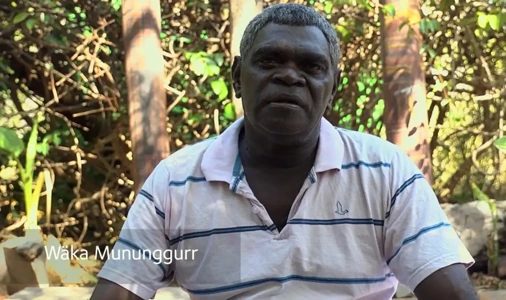
Wäka Mununggurr
Published: 13 Jul 2026
Meet Wäka Mununggurr is from the Djapu clan of the Yolŋu people.
Wäka Mununggurr is from the Djapu clan of the Yolŋu people and is the son of Wonggu Mununggurr, who is a highly influential Yolŋu leader and artist. Wäka is a respected ceremonial leader, and cultural authority, his people are from Northeast Arnhem Land and is widely recognised for his lifelong contribution
to culture, community and connection to country.
His leadership spans decades of change, from historic land rights movement and advocacy, presently represented within his role as a Cultural Advisor with the Department of Housing, Local Government and Community Development.
Wäka is a highly important person and asset to both the Northern Territory Public Sector (NTPS) and the wider community, carrying lifelong knowledge and culture that can only be shared through direct engagement, conversation, and experiencing his work.
Key highlight’s of Wäka’s life and career
Read about Wäka's life and career.
1970s – Homelands movement, encompasses themes of identity, governance and community rights.
Wäka grew up during the homelands movement of the 1970s, when clan leaders led their people according to traditional law, cultural practices and their way of life. Families lived on and cared for their traditional land, established self-sufficient homelands and built independent communities grounded
in culture and connection to Country.
He was a part of the Yirrkala Homelands School environment, where he was immersed in Yolŋu language, traditional knowledge and his passion for education developed. Growing up in this environment grounded him in his Yolŋu identity and instilled a deep connection to his culture, community and Country.
During this time, Wäka witnessed the introduction of the Aboriginal Land Rights (Northern Territory) Act 1976, landmark legislation that formally recognised Aboriginal land ownership and land rights in the Northern Territory.
1980s – Strengthening culture and community
He continued to live and learn on Country at Wändawuy homelands community, practicing traditional law and ceremony while taking on increasing cultural responsibility. During this period Wäka deepened his cultural knowledge and responsibilities, contributing to strong community governance and the continuation
of Yolnju culture.
1990s – Leadership and advocacy
In 1996, Wäka took action after discovering an illegal fishing camp, an event that triggered the Sea Rights claim.
In 1997, he became a Board member of the Laynhapuy Homelands Association, leading and representing homelands communities.
In 1988, he became associated with the era of the Barunga Statement, calling for treaty and self-determination. During this time Wäka emerged as a respected leader, taking action to protect Country and advocating for homelands communities through strong leadership and representation.
2000s – Major outcomes and legal recognition
In 2008 Wäka’s leadership and advocacy played an important role in the landmark Blue Mud Bay High Court decision, which recognised sea rights for Traditional Owners. This decision was the culmination of decades of advocacy, persistence and determination by Wäka and his people.
The ruling confirmed that Aboriginal land ownership extends to the intertidal zone - 'wet or dry' requiring commercial and recreational fishers to seek permission from Traditional Owners to access tidal waters over Aboriginal land. Widely regarded as one of the most significant legal decisions since
Mabo, it marked a major achievement for Wäka, his community and Aboriginal sea rights.
Learn more about Wäka’s story PDF (730.3 KB).